I hope you are all doing all right during the COVID-19 lockdown. Many of you are spending your time trying out new culinary delights, so I thought I’d throw this one into the mix.
I happened to get a container of beautiful fresh currants in a recent Misfits Market box and decided to do the simplest (and most practical) thing with it: jam.
Fresh currants are somewhat hard to find (at least in my part of the world), so this is a (really) small batch recipe. This will essentially give you enough jam for about 4 pieces of toast (or 2, if you like to slather it on).
Red Currant Jam
6 oz. red currants ¼ c + 3 tablespoons sugar
Wash the currants well by placing them in a bowl of water and adding a little vegetable wash or dish soap. Rinse them well in a mesh strainer (especially if you use dish soap).
Remove the stems and discard them. If you’re going to use the traditional canning method, prepare a small jar.
Place the currants in a small nonreactive (non-aluminum) pot and crush them lightly with a fork or potato masher.Add the sugar and 2 teaspoons water and stir. Bring to a boil over high heat. Continue to boil, stirring frequently, until the mixture coats the back of a spoon without dripping, about 10 to 15 minutes.Spoon the jam into a clean jar and seal it. If you’ve sealed it using the canning method, the jam will keep sealed up to a year. Otherwise, refrigerate up to 3 weeks.
Hello again. Thanks for coming back to see where I am in my 20 Regions of Italy project, based on the book La Cucina—The Regional Cooking of Italy by Accademia Italiana della Cucina (The Italian Academy of Cuisine).
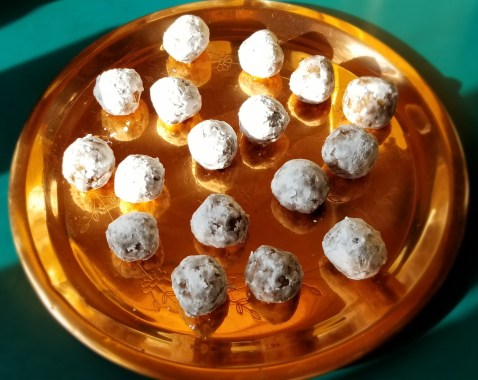
Again, I’m going to take a step back from Emilia-Romagna to Campania. This time, I made Palline di Castagne, or Chestnut Balls. They resemble chocolate truffles in appearance, but have a unique flavor.
I must say that some recipes benefit from a test run and a re-do, and this is one of those recipes, because the first batch I made was inedible, while the second batch was really good and worthy of serving to guests. But I did make one very important modification.
The recipe calls for 1 cup milk, which, as I discovered, was way too much. The resulting confections were much too wet. So much so that they couldn’t be rolled out into smooth balls, and the texture was very off-putting. I must confess that I made half the recipe (in other words, I used ½ cup milk). The ingredients are few enough and simple enough that halving the recipe wasn’t a problem, but I have to wonder if, somehow, it affected the end product. However, I don’t think this was the case. What I did with the second batch was to add a little bit of milk, a little at a time, just until the ingredients held together. In total, I used maybe a couple of tablespoons.
Here’s my personal tip: The original recipe says to pass the cooked chestnuts through a sieve. I tried this method and found that, because of their texture, some of the chestnuts gets trapped in the mesh of the strainer. I found it to be both messy and wasteful. Then I tried grating it, and the result was pretty much the same, if not worse. I found that using a food processor works best. It does the job quickly, with minimal mess, and the least amount of waste. It may not be traditional, but it’s the most effective.
I’m giving half the recipe here because it made 28, and I feel that’s a good number of confections to make. Of course, if you want to make a full batch, just double everything. But be careful with that milk!
Palline di Castagne
Chestnut Balls
Makes 28.
1 pound chestnuts 2½ tablespoons sugar 1 tablespoon bitter cocoa powder 2 tablespoons rum or Marsala wine
¼ cup whole milk ½ cup confectioners’ sugar
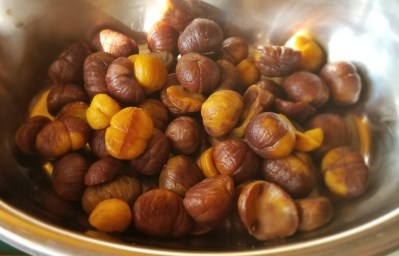
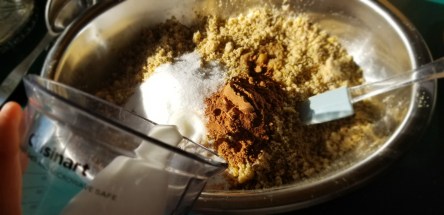
Using a paring knife, cut an “x” in the flat sides of the chestnuts, or cut a little flap in the top part of the chestnuts. Place the chestnuts in a medium pot and cover with water. Bring the pot to a boil; lower the heat and simmer until the chestnuts are tender, about 20 minutes. Drain the chestnuts and let them cool. When they’re cool enough to handle, peel them.Pulverize them either by passing them through a mesh sieve, grating them, or pulsing them in a food processor. Transfer the mixture to a medium bowl.Add the sugar, cocoa power, and rum or Marsala and stir. Begin adding the milk a little at a time just until the mixture holds together. Mix well.Spread the confectioners’ sugar out on a plate.
Take a tablespoon of the mixture and roll it into a ball. Make a few more and place them in the sugar. Roll them around to coat them fully and place them on a platter. Repeat with the remaining mixture.Arrange them on a plate and serve. You can make these a day or two ahead of time, but wait until the last minute to roll them in the sugar because the sugar will eventually melt.
Hello again. Welcome back to my Regions Italy project, based on La Cucina—The Regional Cooking of Italy by Accademia Italiana della Cucina (The Italian Academy of Cuisine). This week on our journey, we stop in Emilia-Romagna, in northern Italy. The capital of Emilia-Romagna is the well-known city of Bologna, but it’s also home to Modena, which is best known as the place of origin of balsamic vinegar. The recipe I have for you today come, in fact, from that city of black gold (balsamic, that is).
The technical aspects of this recipe weren’t too bad, but there were a couple of points that made me scratch my head. The first thing was the bread. The original recipe called for the “bread of 1 roll soaked in milk and squeezed dry.” What kind of roll? How big? Crust included or just the crumb? How much milk? My conclusions are in the recipe below.
The second thing was in the instructions where it said to whip the egg whites and fold it into the mixture. Well, whip them to what stage? Soft peaks? Stiff peaks? Just until thickened? In the end, I went with soft peaks.
The headnote on this recipe says that in place of the almonds, you can use finely crushed amaretti, which are Italian almond cookies. I haven’t tried this alternative yet, but I’ll bet it’s even better than the original.
Pesche Ripiene
Stuffed Peaches
1 hero roll ½ cup milk 1 tablespoon unsalted butter 8 large ripe peaches 3 large eggs, separated 1 cup sugar 1 cup blanched almonds, finely ground, or 1¼ cup almond flour Confectioners’ sugar
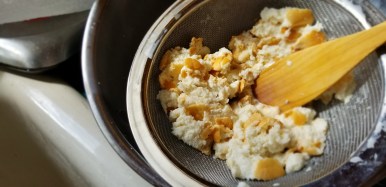
Remove the crumb from the hero and place it in a bowl. Pour the milk over it and let it soak about 5 minutes.(I used the crust as well, but only because it was really soft.)Place the bread in a mesh strainer and press it with a wooden spoon or rubber spatula and squeeze out as much milk as possible.Preheat the oven to 300 degrees F. Grease a large baking sheet or casserole with the butter.
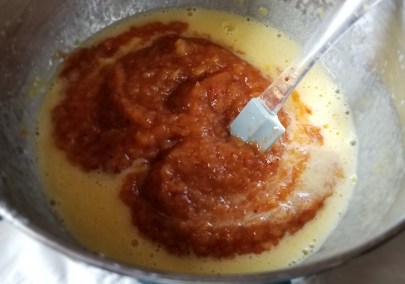
Cut the peaches in half and remove the pits. Scoop out as much of the flesh as you can, leaving a thin layer, so that you get a shell. Depending on how ripe your peaches are, this may be more or less difficult. If the peaches are very ripe and mushy and you can easily scoop it out with a spoon, then just put the pulp in a bowl. If you have to use a paring knife and the flesh is still solid, place the flesh in a food processor or blender (a mini would be perfect here!). Process until it’s mostly pureed, then transfer it to a bowl.Whisk the egg yolks with the sugar until pale and thick, about 3 to 4 minutes. Add this to the peach pulp. Add the drained bread and almond flour. Mix well.Whip the egg whites until soft peaks form, about 4 to 5 minutes. Fold it into the peach mixture.Fill each peach shell with the filling and place them on the baking sheet. Bake until peaches are tender and filling is somewhat firm, about 30 to 45 minutes.
Let them cool slightly. Dust them with confectioners’ sugar and serve warm.
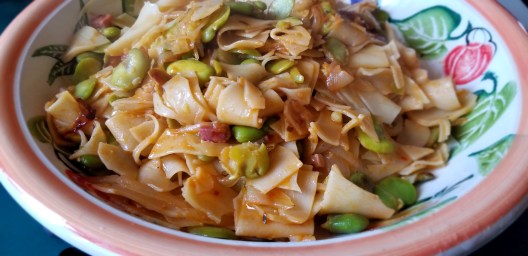
The first recipe in my Regions of Italy project is Pasta con le Fave, or Pasta with Fava Beans. This dish is typical of the Vomano valley of Abruzzo. Although the original recipe calls for marjoram, fresh marjoram can be difficult to find. Oregano is related to marjoram and is more readily available. Note that it’s also stronger in flavor, so you may want to cut back a little on it, if strong herb flavor isn’t your thing.
The pasta called for here is maltagliati, which literally means “badly cut.” They are flat, very wide, short noodles that look like someone got drunk, took a pair of scissors, and went crazy on some dough. You may have a difficult time finding this pasta (although it may be available where specialty Italian products are sold), so you can improvise: cook some pappardelle, place them in a bowl, and use kitchen shears to snip them into squares.
The original recipe did not indicate how well the onion should be sautéed, so I decided on soft and translucent. It also said nothing about whether or not to skin the fava beans. Now, here’s the thing about fava beans. When you remove fresh favas from their pods, they have a skin, or jacket. Although this skin is edible, it can sometimes be tough and cause gas. It’s a much more pleasant experience to eat favas without their skin. The creators of this recipe may have assumed that the readers know to remove the skins, but that’s not always the case. So, I’ve included that step in my instructions.
This is very much a peasant dish, but it’s regal in its simplicity and respect of ingredients. Enjoy!Continue reading →
Do you still have cranberry sauce left over after the holidays? I know some of you do. Admit it. You’ll see lots of sites and professional chefs telling you that everything should be thrown out three days after the holiday. I have news for you—if you’ve stored it properly, that cranberry sauce is probably still good. The thing is, because of the sugar content, cranberry sauce has a long shelf life. It’s just like a jar of jam or preserves in your refrigerator. (Of course, if it smells or tastes funny, or if it has mold on it, throw it out.) For those of you who prefer the stuff that comes in cans (you can admit that, too, don’t be ashamed), you can use those up as well, so that they don’t sit in your pantry for another year.
There are many things you can do with leftover cranberry sauce. One way to use it up is to make a dressing with it, and I’ve done just that. I paired homemade cranberry sauce here with baby greens and Anjou pears. So that the cranberry doesn’t overwhelm the delicate ingredients, I strained the dressing.
So, why not start out with plain cranberry sauce (such as what comes in a can) instead of whole berry sauce, you ask. Because I think that whole berry sauce has so much more depth of flavor than flat cranberry sauce. Plus, chances are that if you have a significant amount left over, it’s probably the homemade kind, which is most likely going to be chunky.
You can adjust the recipe to any flavor profile you like. Enjoy!
Cranberry Sauce Vinaigrette
Makes ¾ cup dressing.
1 cup whole berry cranberry sauce 2 tablespoons balsamic vinegar 1 teaspoon stone-ground mustard 1 teaspoon sea salt Freshly ground pepper to taste
3 tablespoons extra virgin olive oil
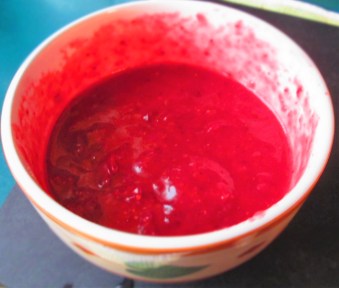
In a medium bowl, combine the cranberry sauce, balsamic vinegar, mustard, salt, pepper, and ¼ cup water. Drizzle in the oil and whisk together well. Using a rubber spatula, strain the dressing through a mesh strainer into another bowl. Taste for seasoning and adjust if you like.
Pear-Pignoli Salad with Cranberry Sauce Vinaigrette
Makes 4 servings.
2 Anjou pears (ripe but still firm) 6 oz. mixed baby greens ¼ cup pignoli (pine nuts), toasted ¼ cup Cranberry Sauce Vinaigrette 2 tablespoons black sesame seeds
Slice the pears about ¼ inch thick. You want them somewhat thin, but not so thin that they fall apart in the salad. Place them in a large bowl. Add the greens and pignoli and toss gently. Add the dressing and again toss gently. Transfer the salad to a serving platter and arrange neatly. Sprinkle the sesame seeds over the top.
Hello, everyone! As we approach the end of another year, many cultures around the world begin their preparations for carrying out traditions that will ensure good luck, good health, and prosperity in the new year (at the very least, they can’t hurt). Food always—pretty much without exception—plays a part in these rituals.
Soba Noodles
In Japan, for example, it is customary to eat soba noodles during the New Year’s celebration to ensure a long life, symbolized by the long noodles. In Spain, 12 grapes are eaten at midnight on New Year’s Eve—one for each month of the year—and it is hoped that the grapes are sweet, which is considered a harbinger of a sweet year ahead. In Austria and Germany, they eat little marzipan pigs, which are considered good luck. In the Philippines, they make a lot of noise on New Year’s Eve, banging pots and pans, to ward off evil spirits. In Greece, they smash a pomegranate at the front door to spill the seeds, symbolically spreading wealth.
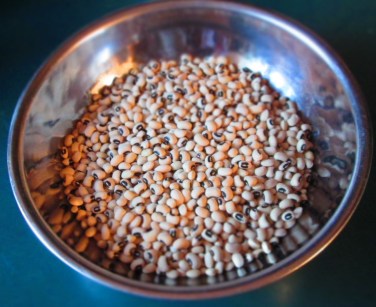
In many countries, legumes are popular for New Year’s because they swell when cooked, symbolizing increased financial prosperity. Lentils are used in Italy and Brazil because they are round like coins. In the United States, black-eyed peas are popular (the musical group and the legume) and Hoppin’ John, which features that particular legume, is a staple New Year’s dish in the South.
Recipes for Hoppin’ John first began appearing in cookbooks in the 1840s, but the origins are a little murky, and possibly a little unfortunate. Black-eyed peas are native to West Africa, and it’s believed that they were brought over by slave traders as part of their cargo. Naturally, the crops were planted in the South, and became an important commodity. Some believe that eating black-eyed peas for New Year’s is actually a carryover of a 1500-year-old tradition of consuming them by Sephardic Jews on Rosh Hashanah, the Jewish New Year.
The beans themselves represent coins, and there’s one version of this tradition that calls for hiding an actual coin in the Hoppin’ John—bringing the finder good luck—as well as filling a bowl with beans and coins and leaving it on the table for some benevolent spirit in exchange for granting good fortune.
But why is it called Hoppin’ John? There are several stories. One says that there was an old man who hobbled around and sold peas on the streets of Charleston, and the dish was named after him. Another says that children would hop around the dinner table, eagerly anticipating the serving of this dish. A more likely story is that it comes from a French term, pois pigeons, meaning pigeon peas, which are a big part of Caribbean culture.
Hoppin’ John is traditionally made with pork and served with rice. In many countries, pork, for some reason, is considered lucky to eat on New Year’s (marzipan is not the only kind of pig that Austrians and Germans eat for New Year’s). Rice flourished in the hot, steamy South (it was dubbed at one point Carolina Gold). Bring all three of these elements together, you’ve got one lucky dish. Also, Hoppin’ John is often served together with collard greens, because it represents money. Cornbread, too, is considered lucky because of its “golden” color (you get the idea).
I’ve made different versions of Hoppin’ John, with and without greens, with and without meat, with rice and with other grains… This is probably the simplest version I’ve cooked. The nice thing about it is that you can make it ahead of time and freeze it, then defrost it in time for New Year’s Day. By the way, unlike other dried beans, black-eyed peas do not need to be pre-soaked. You can, if you want to cut down cooking time, do a quick-soak method by bringing the peas to a boil in a pot of water, letting them boil for 2 minutes, then letting them sit in the water for an hour off heat. But, frankly, if you’re going to do all of that, you’re not really saving any time, unless you want to do this the day before. In my opinion, not worth it. Just let the Hoppin’ John cook for an hour, and it’s a done deal.
Whatever traditions you have for New Year’s—or whether you have any at all—I’m wishing you all a healthy, happy, prosperous New Year. I wish for peace and tranquility, honor and compassion, and above all, respect for all living beings.
Hoppin’ John
Makes 6 servings.
1 tablespoon olive oil 1 medium red onion, chopped 1 tablespoon kosher salt 4 garlic cloves, minced
1 tablespoon tomato paste 6 cups vegetable broth 1 small green bell pepper, chopped 1 cup coarsely chopped carrot 2 large celery ribs, chopped 1 cup chopped tomatoes, liquid reserved 3 cups dried black-eyed peas 1 or 2 dried bay leaves Freshly ground black pepper ¼ cup minced fresh parsley
2 teaspoons fresh minced thyme or rosemary (or both), optional
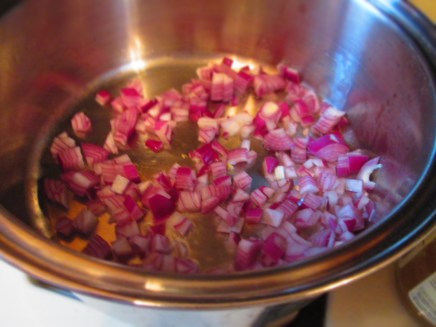
Heat the oil in a Dutch oven or large saucepan. Add the onion and ¼ teaspoon of the salt, and sauté over medium-high heat until soft and translucent.Add the garlic and sauté until fragrant, 1 to 2 minutes. Drop in the tomato paste and stir it in until it’s well blended, then let it cook for a minute or two, until the bottom of the pot starts to brown.Pour in a little bit of the broth to deglaze the pot and scrape up the brown bits with a wooden spoon. Let this cook until the liquid has evaporated.Add the bell pepper, carrot, celery, and ½ teaspoon of the salt and sauté until all the vegetables have softened but are still firm.Pour the liquid from the tomatoes into a measuring cup and add enough water to make 1 cup. Add this to the pot. Pour in the broth, and add the beans, bay leaves, remaining salt, and black pepper. Mix well.Bring this to a boil; lower the heat to medium-low and simmer, partially covered, about 1 hour, or until the beans are tender but not mushy. If the pot dries out before the beans are cooked, add more water or broth and stir it in. Stir in the parsley and other herbs and taste for seasoning. Add more salt and/or pepper, if you like.
Remove the bay leaves and serve with rice or cornbread, or on its own.
Every season brings with it its own special delicious crops. One of my favorite autumn vegetables is Brussels sprouts. Earthy, cabbage-y, and slightly bitter, Brussels sprouts have traditionally been underrated, and even reviled. Even the words “Brussels sprouts” can bring a look of revulsion to some people’s faces.
O ye, of little faith. You poor honeys just haven’t had them cooked right.
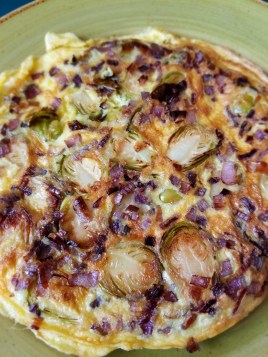
I have used Brussels sprouts in many dishes, but I had never made them in a frittata. Until now. I loved it.
Frittatas, in general, are very forgiving. You can add just about anything and it will taste good. Brussels sprouts are no exception. Paired with red onions, they make this frittata hearty, flavorful, and elegant enough to serve others.
Enjoy!
Brussels Sprouts-and-Red Onion Frittata
Makes 4 servings.
½ lb. Brussels sprouts, trimmed and halved 2 tablespoons olive oil 1 teaspoon kosher salt
1/3 cup finely chopped red onion 3 large eggs 1 tablespoon grated parmesan cheese Freshly ground black pepper
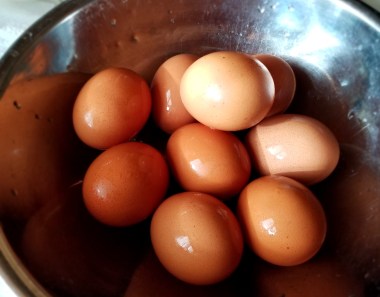
Preheat the oven the 350 degrees F/176 degrees C.Place the Brussels sprouts in a medium bowl. Add 1 tablespoon of the oil and ½ teaspoon of the salt. Toss until all the sprouts are coated. Spread them out on a baking sheet and roast until nicely browned and tender when pierced with the tip of a knife.Beat the eggs in a medium bowl with the remaining salt, parmesan, and black pepper.
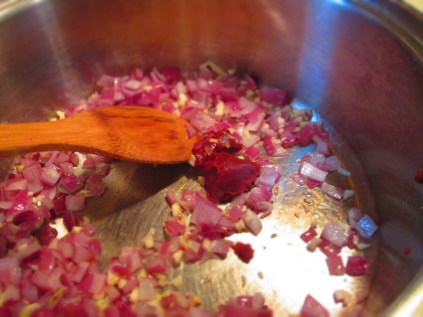
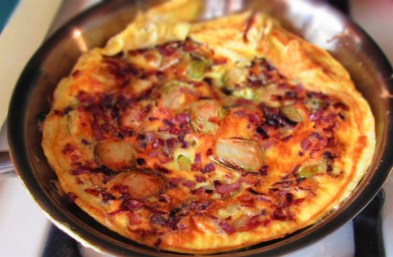
Heat the remaining oil in a small skillet. Add the onion and sauté until they’ve softened and just start to brown, about 2 minutes. Add the Brussels sprouts and spread them out evenly (try to face them cut side down for a nice presentation). Pour the eggs evenly over the onion and sprouts. Lower the heat to low and cover the pan. Cook until the underside of the frittata is browned, about 5 to 7 minutes. (You can check by lifting the frittata on one side with a spatula and peeking underneath.)
Place a plate that is wider than the skillet over the top and a carefully (using a dry kitchen towel or potholder!), flip the frittata over onto the plate. Then slide the frittata back into the skillet.Continue cooking a few more minutes, uncovered, until the frittata is cooked through and the underside has browned.
Remove it from the pan and cut into 4 wedges. Serve hot, warm, or cold.
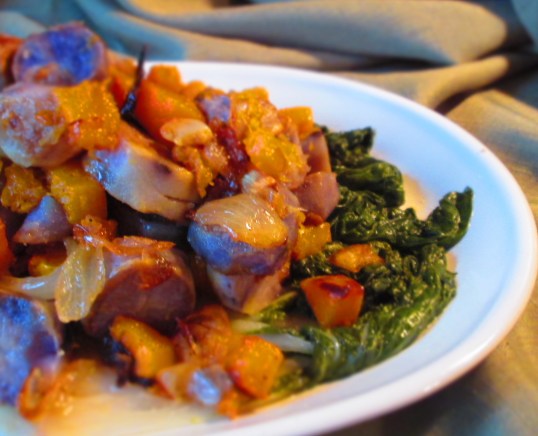
Roasting is my favorite way to cook almost any vegetable, but it’s definitely the way to go with root vegetables and squashes. Because it’s so easy, this is the perfect dish to serve at any weeknight meal. But because it’s easily doubled or tripled, it’s ideal for the Thanksgiving table, or for any special autumn or winter meal. Enjoy.
Roasted Squash and Purple Potatoes with Baby Bok Choy
Makes 4 to 6 servings.
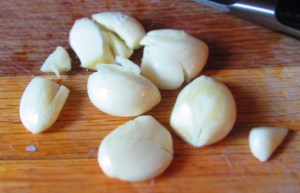
6-7 large garlic cloves, peeled 2 cups cubed butternut or other winter squash 2 cups cubed purple potatoes (about 1½ pounds) 1 small onion, sliced 3 tablespoons + 1 teaspoon olive oil 3 teaspoons kosher salt ½ pound baby bok choy Preheat the oven to 375 degrees F.
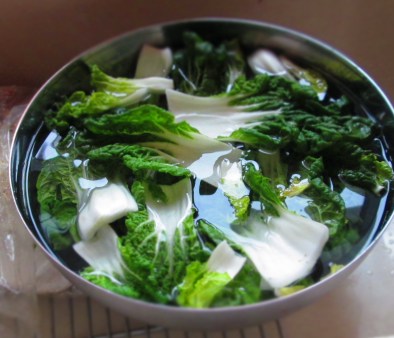
Slice 1 garlic clove and set aside. Smash the rest with the flat side of a knife blade (hit your palm CAREFULLY down on the blade).Combine the squash, potatoes, onions, and smashed garlic in a medium bowl. Add 3 tablespoons of the oil and 2 teaspoons of the salt and mix well. Transfer to a baking sheet and roast until the vegetables are tender and golden brown, about 40 to 45 minutes. Stir halfway through.Meanwhile, make the bok choy. Slice off the root end and separate the leaves. Soak the leaves in a bowl of cool water for about 10 minutes. Remove the bok choy and rinse them.Heat the remaining oil in a medium skillet. Add the sliced garlic and sauté until fragrant, about 1 to 2 minutes. Add the bok choy and remaining salt and cook, covered, for 5 minutes. Uncover the pan and continue cooking over medium heat until tender. Taste for seasoning and adjust if needed.Place the bok choy neatly on a platter. Spoon the squash and potatoes over the bok choy. Serve hot.
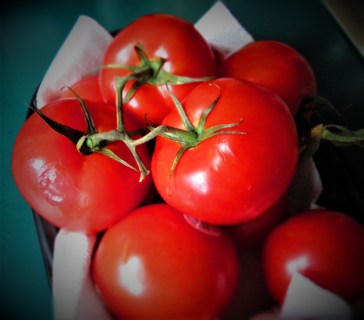
All of my life, I never liked tomato soup. It always tasted like watered-down ketchup to me. Granted, my experience with tomato soup had been the canned variety, but I also had once or twice tried it in a restaurant or catered affair situation (I can’t remember which) and thought it was equally distasteful.
Then, I found a recipe for tomato soup using fresh tomatoes…and it changed my world. Now I knew what tomato soup was supposed to taste like. And I never looked back.
This is my recipe for fresh tomato soup. The ingredients are extremely simple and the focus is on the tomatoes. It’s best to make this in summer, when tomatoes are at their peak. It doesn’t much matter which variety you choose, as long as they’re ripe and fresh. Enjoy!Continue reading →
Listen, it’s just been too damn hot to cook. The dog days of summer are upon us. Temperatures are making the mercury in (old school) thermometers cry, and you could fry your entire breakfast on the streets. Understandably, you don’t want to be in the kitchen for any longer than it takes to pour a glass of lemonade.
But most people don’t seem to have a problem spending a few minutes pressing a button on a blender for a nice, frothy, alcoholic beverage With the promise of a delicious fruit-based libation, spending that time at the kitchen counter will be worth it, especially with a recipe as easy as this one.
For this recipe, I used a premade fruit puree by Perfect Puree, but there are other brands of purees out there. There are many different flavors and they’re nice to have around for summertime beverages, as well as desserts and savory dishes. You can keep them in your refrigerator for short-term use, or the freezer for long-term storage. However, if you can’t get your hands on these purees, you can make your own. For this recipe, simply peel and seed a green apple.
Apple Cocktail
Makes 2 cocktails.
2 oz. green apple puree 4 oz. apple rum ice Garnish: Sliced apples (optional)
Combing the puree and rum in a blender. Add a few ice cubes and puree. Pour into 2 martini glasses. Garnish the edge of the glasses with apple slices.

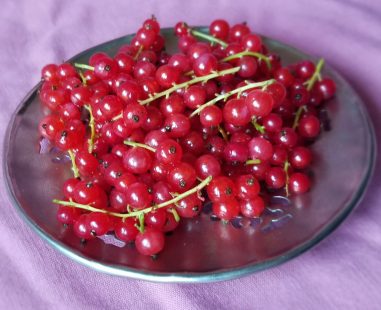
 Add the sugar and 2 teaspoons water and stir. Bring to a boil over high heat. Continue to boil, stirring frequently, until the mixture coats the back of a spoon without dripping, about 10 to 15 minutes.
 Spoon the jam into a clean jar and seal it. If you’ve sealed it using the canning method, the jam will keep sealed up to a year. Otherwise, refrigerate up to 3 weeks.



 Spread the confectioners’ sugar out on a plate.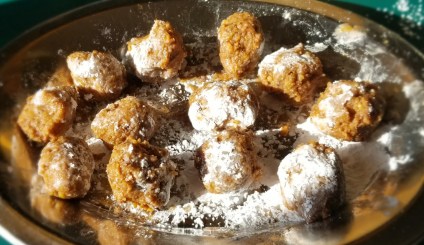







 Do you still have cranberry sauce left over after the holidays? I know some of you do. Admit it. You’ll see lots of sites and professional chefs telling you that everything should be thrown out three days after the holiday. I have news for you—if you’ve stored it properly, that cranberry sauce is probably still good.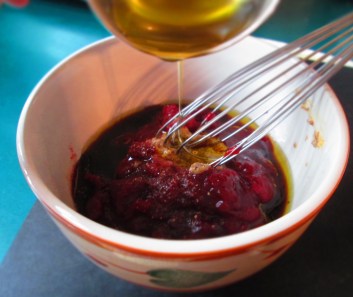










 H
H



 Listen, it’s just been too damn hot to cook. The dog days of summer are upon us. Temperatures are making the mercury in (old school) thermometers cry, and you could fry your entire breakfast on the streets. Understandably, you don’t want to be in the kitchen for any longer than it takes to pour a glass of lemonade.
  Miz Chef