I hope you are all doing all right during the COVID-19 lockdown. Many of you are spending your time trying out new culinary delights, so I thought I’d throw this one into the mix.
I happened to get a container of beautiful fresh currants in a recent Misfits Market box and decided to do the simplest (and most practical) thing with it: jam.
Fresh currants are somewhat hard to find (at least in my part of the world), so this is a (really) small batch recipe. This will essentially give you enough jam for about 4 pieces of toast (or 2, if you like to slather it on).
Red Currant Jam
6 oz. red currants ¼ c + 3 tablespoons sugar
Wash the currants well by placing them in a bowl of water and adding a little vegetable wash or dish soap. Rinse them well in a mesh strainer (especially if you use dish soap).
Remove the stems and discard them. If you’re going to use the traditional canning method, prepare a small jar.
Place the currants in a small nonreactive (non-aluminum) pot and crush them lightly with a fork or potato masher.Add the sugar and 2 teaspoons water and stir. Bring to a boil over high heat. Continue to boil, stirring frequently, until the mixture coats the back of a spoon without dripping, about 10 to 15 minutes.Spoon the jam into a clean jar and seal it. If you’ve sealed it using the canning method, the jam will keep sealed up to a year. Otherwise, refrigerate up to 3 weeks.
Welcome back to my Regions of Italy project, based on La Cucina—The Regional Cooking of Italy by Accademia Italiana della Cucina (The Italian Academy of Cuisine).
As I write this, the world is in the thick fog of the pandemic COVID-19, or coronavirus. With so many of you in quarantine (or more diplomatically referred to as shelter in place), you’re trying out all those recipes you’ve been wanting to try. Well, now’s a great time to journey with me through Italy.
Today, we’re in Lombardia and I’m offering one of that region’s specialties, squash cake. Although it’s called cake, it’s actually more like a savory loaf with a sweet edge, kind of like corn bread.
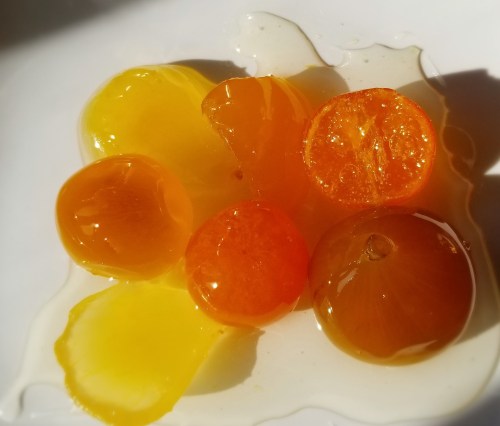
What makes this recipe unusual is that it calls for mostarda di Cremona. Also known as mostarda di frutta, it’s candied fruit packed in mustard syrup. (Mostarda di Cremona, from the town of Cremona, is a particular blend of whole or large pieces of various fruit, and is the most well-known variety of mostarda.) If you taste it right out of the jar, you get hit with an unmistakable mustard flavor, reminiscent of yellow mustard, with only an undertone of sweetness. Once incorporated into a dish, the flavor blends in seamlessly and you end up with a complex recipe with an interesting flavor that you can’t quite pinpoint (but it’s the mostarda!).
Anyway, try it out. I hope you like it.
By the way, the note in the original recipe says it’s best to make the mixture a day ahead, but I missed my opportunity to do that. I made it the same day and it was fine.
Hi there. This week, I decided to take a little rest stop on my ongoing journey through my Regions of Italy project.
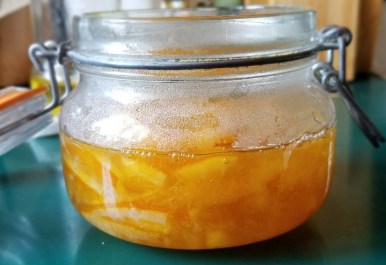
So I got these two Meyer lemons in my Misfits Market box and was trying to figure out what to do with them. Two is not enough to do any kind of substantial lemon dessert (like a pie). What could I make with just two? Then it occurred to me that I could make a nice little batch of marmalade. So that’s what I did. The recipe is very simple. As you can see, there are only two ingredients, plus water. That’s it.
Originally from China, Meyers lemons are a cross between lemons and a mandarin oranges. It has sweeter flavor than regular lemons with a distinct orangey taste. The skin, rather than being “lemon yellow,” has an orange blush to it. It’s also edible.
Quarter the lemons length wise, then slice each quarter thinly. Remove as many seeds as possible.Place the lemons in a medium saucepan (not aluminum!) and add 1 1/3 cups water. Cover the pot and leave it out at room temperature overnight (at least 12 hours).Bring the pot to a boil, then lower the heat to medium-low. Simmer, uncovered, until the liquid is reduced to half, about 20 minutes.
Add the sugar and return to a boil. Simmer over medium heat, uncovered, until the mixture is thick. Stir occasionally and skim off any foam from the top. This should take about 15 minutes. You’ll know it’s done by doing the plate test: Place a small plate or bowl in the freezer for a few minutes, then take it out and drop a little of the lemon liquid on it. After a minute, it should gel up.Transfer the marmalade to a small jar with a tight-fitting lid and seal while hot. If you want to store the marmalade for long term, boil the jars for 5 to 10 minutes. Otherwise, it should stay in the refrigerator up to 6 weeks.
Hello. This week for my Regions of Italy project, based on La Cucina—The Regional Cooking of Italy by Accademia Italiana della Cucina (The Italian Academy of Cuisine), I’m in Liguria. Liguria sits in a crescent along the Mediterranean coastline on the west side of Italy.
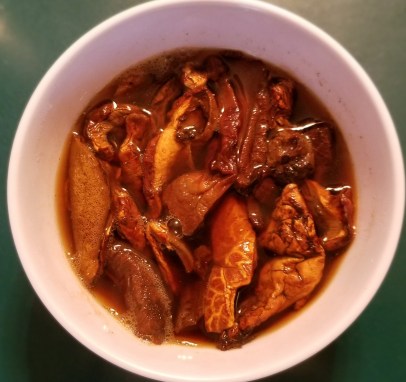
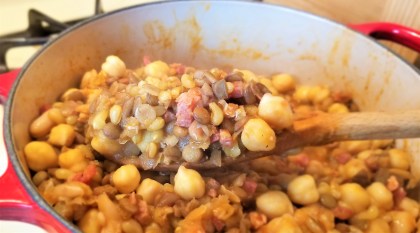
My first recipe for this region is Zimino di Ceci, or Chickpea Stew. This is a pretty easy recipe, and quick, if you don’t count the overnight soaking time. The ingredients list calls for a few items that require prep (although minimal) before using them in the recipe. So I’ve moved the prep instructions for these items to the recipe itself. The other thing I did was to add the mushroom soaking liquid to the stew, which gave it a nice depth of flavor.
Enjoy.
Zimino di Ceci
Chickpea Stew
Makes 4-6 servings.
1½ cups dried chickpeas, soaked overnight* ½ teaspoon sea salt, plus extra 1 ounce dried porcini mushrooms 3 or 4 ripe plum tomatoes
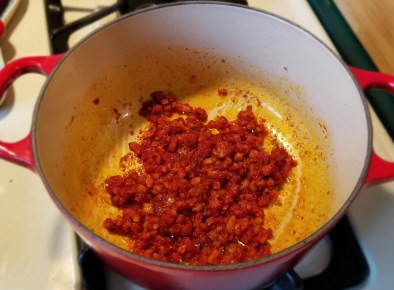
2 tablespoons extra virgin olive oil 1 medium onion, finely chopped 1 celery rib, chopped 1 garlic clove, minced ¾ pound Swiss chard, chopped Toasted bread (optional)
Drain the chickpeas and rinse them. Place them in a large pot and cover them with fresh water by about 3 inches. Add ¼ teaspoon salt and bring to a boil; lower the heat to medium-low and simmer, partially covered, until they’re tender, about 2 to 2 ½ hours.
Meanwhile, soak the mushrooms in water for about 15 minutes. Drain them and pat them dry with paper towels or a kitchen towel. Chop and set them aside.Bring a pot large enough to fit the tomatoes and fill with water. Cut an “x” into the top of the tomatoes and place them in the water for about 10 to 15 seconds (until you see the skin splitting apart). Scoop them out and let them cool. When they’re cool enough to handle, peel off the skin, remove the seeds, and chop them. Set them aside.Drain the chickpeas in a colander set over a bowl and reserve the liquid.Wipe out the pot. Add the oil and heat. Add the onion, celery, garlic, and mushrooms (reserve the liquid), and ¼ teaspoon salt. Sauté until onions and celery are soft, about 5 minutes. Stir in the tomatoes (and any liquid they gave off). Then add the chard. Cook 2 minutes.Add the chickpeas and cook 10 minutes. Add 1 cup of the reserved chickpea liquid. Carefully pour in the reserved mushroom liquid, making sure to leave any sediment in the bowl. Cook another 5 minutes. If you want it more brothy, add more of the chickpea liquid until it reaches the consistency you like. Taste for seasoning and adjust, if needed.Serve with toasted bread, if desired.
*Place the chickpeas in a bowl and cover them with water by about 3 inches. Cover the bowl and refrigerate for 24 hours.
Hi there. This week on my journey through the Regions of Italy project, based on La Cucina—The Regional Cooking of Italy by Accademia Italiana della Cucina (The Italian Academy of Cuisine). I’m once again in Lazio, this time making a soup. This soup is called Ertuti. I wasn’t able to find any information on this dish, or why it’s called ertuti, but it’s rustic fare at its best. A quintessential peasant dish, it’s bulked up with beans and grains with some cured meats thrown in. (You can omit the meats if you like; I used only a small amount of prosciutto.)
Now, as far as the beans and grains themselves are concerned, the original recipe calls for a pound of mixed legumes, and they included farro in this ingredient. Why, I don’t know. Farro is not a legume; it’s the grain in this beans-and-grains combo. So, in order to make the ingredients list less confounding, I’ve split each legume called for in the original and the farro into separate and equal items. However, if you prefer one more than others, go ahead and change the quantities. Or change out the types. You can also change the grain, if you like. Farro is a hearty whole grain and can be substituted with barley, wheat berries, spelt berries, kamut, triticale, or any hard berry.
Finally, while this is a fairly simple recipe, the instructions were somewhat vague and assumed a certain level of understanding of cooking. I’ve expanded on the instructions to make everything a bit clearer.
Ertuti
Beans and Grains
¼ pound dried chickpeas ¼ pound dried lentils ¼ pound dried fava beans ¼ pound farro 1 tablespoon finely chopped prosciutto ¼ cup finely chopped pancetta 1 small piece salame, chopped (optional) 2 tablespoons tomato paste Kosher salt to taste Freshly ground pepper to taste Slices of whole wheat bread
Soak the chickpeas, lentils, fava beans, and farro separately in water, covered, overnight. Pour out the water and place each in a separate pot. Fill with enough water to cover by 3 inches.Bring to a boil; lower the heat and simmer until tender (each one will vary in time). When tender, drain each legume and farro and reserve some of their cooking liquid (you can use liquid from one pot or combine them).In a large pot, heat the prosciutto, pancetta, and salame until they start to brown.Stir in the tomato paste. Work it in until it’s well blended.Add the beans and farro and stir. Add about ½ cup of the cooking liquid and stir. Cook 20 minutes to combine the flavors. You can add more bean cooking liquid as needed if the pot dries out, or if you want a looser consistency.Season with salt and pepper to your liking. Serve with the whole wheat bread.
Hi there. Welcome once again to my Regions of Italy project, based on La Cucina—The Regional Cooking of Italy by Accademia Italiana della Cucina (The Italian Academy of Cuisine). I’m now entering the region of Lazio, whose principal city is Rome. Rome, of course, is the capital of Italy and the heart of the ancient Roman Empire.
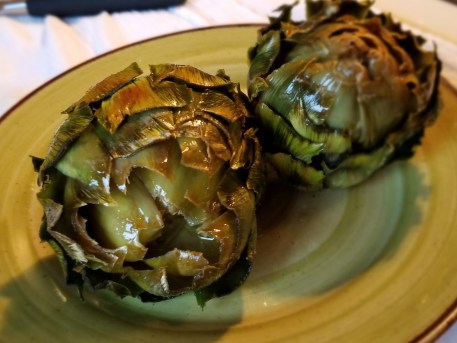
Rome is home to one of the oldest Jewish populations in Europe, and artichokes feature prominently in Roman Jewish cuisine. Carciofi alla Giudia is an iconic dish of the region. The artichokes are smashed open and cooked in oil so that the leaves are crispy and the interiors are tender. As you can see in the photo above, I didn’t do a very good job of keeping the leaves open, but they were delicious anyway.
Here’s a tip: Make sure you use a saucepan that is just big enough to hold the artichokes upright. If there’s too much space in the pan, the artichokes may flop over. (Then again, if you do a better job of keeping them open than I did, maybe it won’t be a problem.)
Carciofi alla Giudia
Jewish-Style Artichokes
Makes 4 servings.
1 lemon, cut in half 4 large globe artichokes
Salt and pepper 4 cups extra virgin olive oil
Fill a large bowl with water and squeeze the lemon into it (this is called acidulating the water). Save the lemon shells.
Remove the tough outer leaves from the artichokes. Cut the stems, leaving only 1 inch, then use a paring knife to trim the tough outer layer of the stem and the bottoms of the artichokes. “At the end, each artichoke should be similar to a flower.” (That’s in the original recipe. I decided to leave it in because, while not very helpful to a novice cook, it’s a lovely description.) Rub all the cut edges of the artichokes with the cut sides of the lemon shells as you trim each one, then place them in the acidulated water.Remove the artichokes from the water and dry them with a towel. Turn each one top down on a hard surface and press firmly. Then spread open each one with your hands. You want to expand the leaves to create an open-flower effect. Sprinkle the insides with salt and pepper. Fill a saucepan with about 3 inches of oil and heat it over medium heat. When it’s hot, immerse the artichokes, stem up, and cook about 10 minutes. With a pair of tongs (two, if you have them), carefully turn them over and arrange them stem down for another 10 minutes.Remove them from the pan and drain them on paper towels. Sprinkle them with a little water to draw out the oil and make them even crisper. Serve hot.
I’m just barely one-third through the regions of my Regions of Italy project, based on La Cucina—The Regional Cooking of Italy by Accademia Italiana della Cucina (The Italian Academy of Cuisine). I skipped a few recipes because of seasonal availability of ingredients, but I’ll get back around to those later. Right now, I’m in Fruili-Venezia Giulia, at the very high point of Italy.
This is another simple but unique recipe. Cornmeal is a common ingredient in this region of Italy, and it figures heavily in a traditional soup called Paparot. It’s a thick, hearty soup, but made properly, it’s silky and luxurious. Although it is traditional to serve it with crusty toasted bread, you can also add some rice or noodles.
Paparot
Spinach-Cornmeal Soup
Makes 6 servings.
2 pounds spinach, washed, large stems removed
¼ teaspoon kosher salt, plus more
4 tablespoons unsalted butter
1 or 2 large garlic cloves, peeled but whole
¾ cup all-purpose flour
8 cups broth
2/3 cup fine cornmeal
Salt to taste
Freshly ground pepper to taste
Boil the spinach in a large pot of water with ¼ teaspoon salt just until wilted, about 3 to 4 minutes. Drain well and squeeze out as much water as possible. Chop the spinach and set aside.
In the same pot, melt the butter over low heat. Add the garlic and saute until golden on all sides. Remove the garlic and add the spinach. Whisk in the flour. Pour in half the broth, stirring constantly to prevent lumps. If any lumps form, work them out with the back of a wooden spoon.Pour in the remainder of the broth, then whisk in the cornmeal. Work out any lumps that form with the back of a wooden spoon. Cook over medium-low heat 30- to 40 minutes, stirring frequently and pressing out lumps, until the soup is thick. Season with salt and pepper.
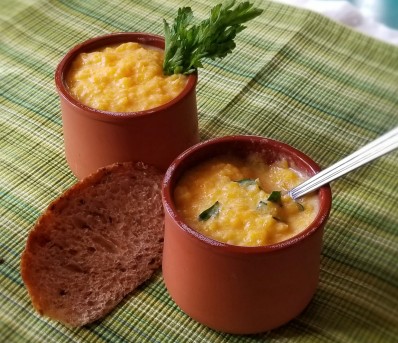
Welcome back to my Regions of Italy project, based on La Cucina—The Regional Cooking of Italy by Accademia Italiana della Cucina (The Italian Academy of Cuisine). This week’s recipe moves us into Fruili-Venezia Giulia, which is in the most northeastern corner of Italy. It borders Austria and Slovenia and it’s cuisine is influenced by those cultures. It uses a lot of root vegetables and hearty grains. The first recipe from the region I offer is a very simple one: butternut squash soup.
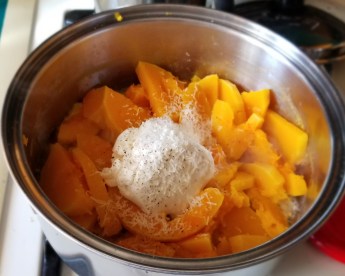
You’ve had butternut squash soup before, right? So have I. It’s a pretty common dish. There’s something a little different about this one, though. After the squash is cooked, a cup of ricotta is stirred in, creating a unique soup. The recipe is straight-forward and I don’t have too much to say about it, except for one thing. The original recipe instructs to “squeeze dry” the squash. I don’t know what they mean by this, but I put the squash in a sieve and pressed on it with a wooden spoon to release excess water. I further tweaked the instructions for clarity, and I thought the soup needed salt (not given in the original recipe). Other than that, it’s all pretty easy. Give it a try. Enjoy.
Minestra di Zucca
Squash Soup
Makes 6 servings.
1 butternut squash, peeled, seeded, and cut into chunks
½ teaspoon kosher salt, plus more to taste
1 tablespoon olive oil
1 tablespoon butter
2 tablespoon all-purpose flour
1 large garlic clove, minced
1 cup ricotta
1 tablespoon grated Parmigiano-Reggiano
Pinch ground cinnamon
Freshly ground black pepper to taste
Place the squash in a pot large enough to hold it all and cover with water. Add ½ teaspoon salt. Bring to a boil; lower the heat to medium-low and simmer until the squash is tender, about 8 to 10 minutes. Drain the squash into a sieve set over a bowl to catch the water. Press the squash to release as much liquid as possible. Reserve the cooking water.Return the pot to the heat. Combine the oil and butter, and heat until the butter has melted. Add the garlic, then whisk in the flour.Add the squash and mash it with a potato masher or a stick blender. Stir in the ricotta, Parmigiano-Reggiano, cinnamon, pepper, and salt. Stir in some of the reserved cooking water until it reaches a consistency to your liking. Taste for seasoning and adjust if necessary.
Ah, caught your eye with that title, didn’t I? Strozzapreti, which literally means “priest-chokers” (strozza=to choke or strangle; preti=priest) is a type of pasta, and it stars in this week’s recipe in my 20 Regions of Italy project, based on the book La Cucina—The Regional Cooking of Italy by Accademia Italiana della Cucina (The Italian Academy of Cuisine).
Here’s the thing: Some pasta names refer to different shapes, depending on what region of Italy you go to, and so it is with strozzapreti. In some regions, strozzapreti look like twisted ropes, whereas in other regions, it refers to various shapes that are large and grow larger as they cook, and can easily be used to choke the local cleric. There are different theories for the origin of the name, from accidental choking to intentional suffocation, but it’s one of the best pasta shape names. (It seems to me that since this name is widespread throughout the country, choking priests must have been a common practice.) In Emilia-Romagna, they resemble what my people from Basilicata referred to as “macaroni.” I looked for something in the supermarket to replicate this and the closest I came was casarecci, or “house-style noodles.” You can also use gemelli, or anything similar. In the case of this specific recipe (i.e., according to the book), this pasta got its name from its white color, due to the lack of eggs, and reminiscent of priests’ collars.
Lischi/agretti
The recipe is from the nineteenth century, but the title of this recipe is misleading. When I first saw it, I assumed I’d be using salsify—that long, black-skinned root vegetable, called scorzanera in Italian (scorza=peel, nera=black). But I was wrong. What this dish actually requires is a marsh grass known in Italian as lischi, agretti or Barba di Frate. The authors of this book (or perhaps the translators) seem to think that lischi are the young leaves of the salsify plant, but I’ve researched it and I’ve come up with no evidence to support this. Maybe somewhere in the translation, they ran across lischi’s latin name, Salsola soda, and confused it with salsify.
Having said all that, lischi is almost impossible to get locally in the U.S., unless you’re lucky enough to encounter
it at a farmers’ market somewhere, grow it yourself, or order it online. The book suggests using Swiss chard leaves as a substitute, but that comes nowhere near replicating lischi. I scoured the many offerings of Asian markets, looking for something similar. Lischi have a grassy, slightly bitter taste, and are long. They look almost like Chinese long beans, only with an oceanic sheen to it, similar to algae, or seaweed. Neither of those things, however, seemed appropriate. In the end, I settled for chives. Not the smallish French, or onion, chives (the kind that you snip on top of your hors d’oeuvres), and not flowering chives, but long, flat-leaf chives, known as garlic chives. The garlicky flavor is very mild when it’s cooked, and it has a similar strand-like appearance to the lischi.
The result was pretty good, and definitely a change of pace from the typical pasta dish.
Flat-leaf chives
Strozzapreti
Priest-Chokers with Salsify Sauce
Makes 4 servings.
½ pound strozzapretti (or other short pasta) 2 teaspoons salt 4 tablespoons unsalted butter 7 ounces pancetta, diced 4 ounces lischi (or flat-leaf chives) 1 cup dry red wine, preferably Sangiovese di Romagna) 2/3 cup grated Parmigiano-Reggiano
Bring a medium pot of water to a boil. Add the pasta and 2 teaspoons salt. Cook, stirring often, until the pasta is al dente, about 8 to 12 minutes, depending on the type you use. Drain well.
Meanwhile, place the lischi (or chives) in another pot and cover with water. Bring it to a boil; lower the heat and simmer until the the vegetables are tender, about 3 to 5 minutes. Drain well.Heat 1 tablespoon of the butter in a medium pan; add the pancetta and saute over low heat until the pancetta has lightly browned. Add the lischi and wine. Simmer over medium heat. When the wine has evaporated, add the cooked strozzapreti and the rest of the butter. Toss to heat. Sprinkle with the Parmigiano-Reggiano and serve.
Hello again. Thanks for coming back to see where I am in my 20 Regions of Italy project, based on the book La Cucina—The Regional Cooking of Italy by Accademia Italiana della Cucina (The Italian Academy of Cuisine).
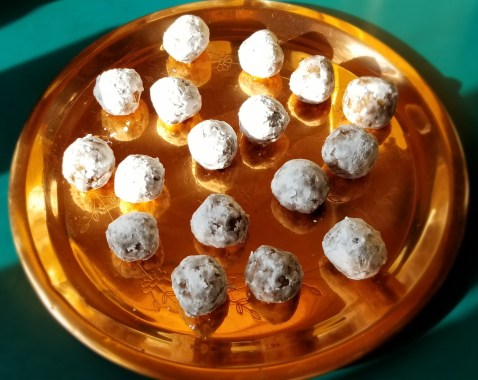
Again, I’m going to take a step back from Emilia-Romagna to Campania. This time, I made Palline di Castagne, or Chestnut Balls. They resemble chocolate truffles in appearance, but have a unique flavor.
I must say that some recipes benefit from a test run and a re-do, and this is one of those recipes, because the first batch I made was inedible, while the second batch was really good and worthy of serving to guests. But I did make one very important modification.
The recipe calls for 1 cup milk, which, as I discovered, was way too much. The resulting confections were much too wet. So much so that they couldn’t be rolled out into smooth balls, and the texture was very off-putting. I must confess that I made half the recipe (in other words, I used ½ cup milk). The ingredients are few enough and simple enough that halving the recipe wasn’t a problem, but I have to wonder if, somehow, it affected the end product. However, I don’t think this was the case. What I did with the second batch was to add a little bit of milk, a little at a time, just until the ingredients held together. In total, I used maybe a couple of tablespoons.
Here’s my personal tip: The original recipe says to pass the cooked chestnuts through a sieve. I tried this method and found that, because of their texture, some of the chestnuts gets trapped in the mesh of the strainer. I found it to be both messy and wasteful. Then I tried grating it, and the result was pretty much the same, if not worse. I found that using a food processor works best. It does the job quickly, with minimal mess, and the least amount of waste. It may not be traditional, but it’s the most effective.
I’m giving half the recipe here because it made 28, and I feel that’s a good number of confections to make. Of course, if you want to make a full batch, just double everything. But be careful with that milk!
Palline di Castagne
Chestnut Balls
Makes 28.
1 pound chestnuts 2½ tablespoons sugar 1 tablespoon bitter cocoa powder 2 tablespoons rum or Marsala wine
¼ cup whole milk ½ cup confectioners’ sugar
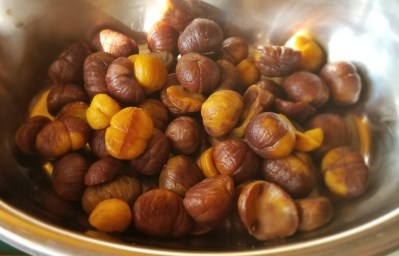
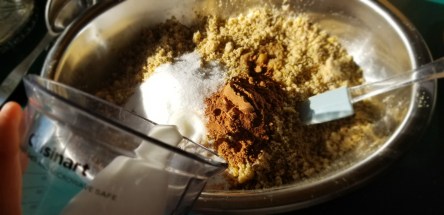
Using a paring knife, cut an “x” in the flat sides of the chestnuts, or cut a little flap in the top part of the chestnuts. Place the chestnuts in a medium pot and cover with water. Bring the pot to a boil; lower the heat and simmer until the chestnuts are tender, about 20 minutes. Drain the chestnuts and let them cool. When they’re cool enough to handle, peel them.Pulverize them either by passing them through a mesh sieve, grating them, or pulsing them in a food processor. Transfer the mixture to a medium bowl.Add the sugar, cocoa power, and rum or Marsala and stir. Begin adding the milk a little at a time just until the mixture holds together. Mix well.Spread the confectioners’ sugar out on a plate.
Take a tablespoon of the mixture and roll it into a ball. Make a few more and place them in the sugar. Roll them around to coat them fully and place them on a platter. Repeat with the remaining mixture.Arrange them on a plate and serve. You can make these a day or two ahead of time, but wait until the last minute to roll them in the sugar because the sugar will eventually melt.

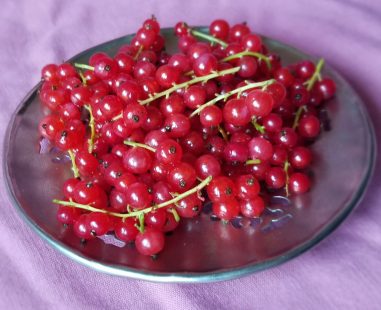
 Add the sugar and 2 teaspoons water and stir. Bring to a boil over high heat. Continue to boil, stirring frequently, until the mixture coats the back of a spoon without dripping, about 10 to 15 minutes.
 Spoon the jam into a clean jar and seal it. If you’ve sealed it using the canning method, the jam will keep sealed up to a year. Otherwise, refrigerate up to 3 weeks.






 Stir in the tomatoes (and any liquid they gave off).



 Lazio
Lazio
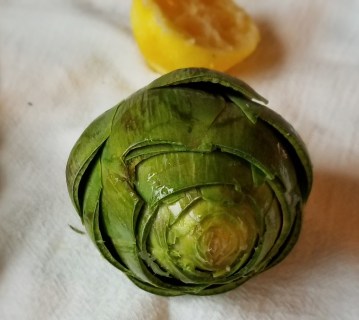 Remove the artichokes from the water and dry them with a towel. Turn each one top down on a hard surface and press firmly. Then spread open each one with your hands. You want to expand the leaves to create an open-flower effect. Sprinkle the insides with salt and pepper.
 Fill a saucepan with about 3 inches of oil and heat it over medium heat. When it’s hot, immerse the artichokes, stem up, and cook about 10 minutes. With a pair of tongs (two, if you have them), carefully turn them over and arrange them stem down for another 10 minutes.


 Remove the garlic and add the spinach.


 Drain the squash into a sieve set over a bowl to catch the water. Press the squash to release as much liquid as possible. Reserve the cooking water.



 Emilia-Romagna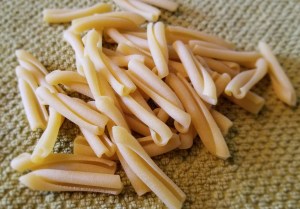


 When the wine has evaporated, add the cooked strozzapreti and the rest of the butter. Toss to heat.
 Sprinkle with the Parmigiano-Reggiano and serve.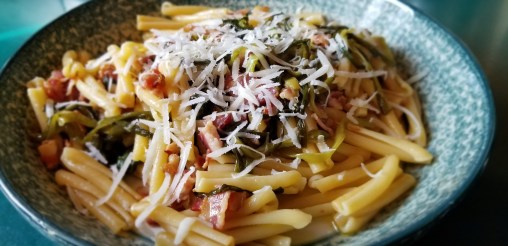



 Spread the confectioners’ sugar out on a plate.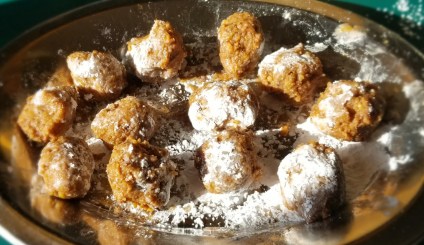

 Miz Chef