Listen, it’s just been too damn hot to cook. The dog days of summer are upon us. Temperatures are making the mercury in (old school) thermometers cry, and you could fry your entire breakfast on the streets. Understandably, you don’t want to be in the kitchen for any longer than it takes to pour a glass of lemonade.
But most people don’t seem to have a problem spending a few minutes pressing a button on a blender for a nice, frothy, alcoholic beverage With the promise of a delicious fruit-based libation, spending that time at the kitchen counter will be worth it, especially with a recipe as easy as this one.
For this recipe, I used a premade fruit puree by Perfect Puree, but there are other brands of purees out there. There are many different flavors and they’re nice to have around for summertime beverages, as well as desserts and savory dishes. You can keep them in your refrigerator for short-term use, or the freezer for long-term storage. However, if you can’t get your hands on these purees, you can make your own. For this recipe, simply peel and seed a green apple.
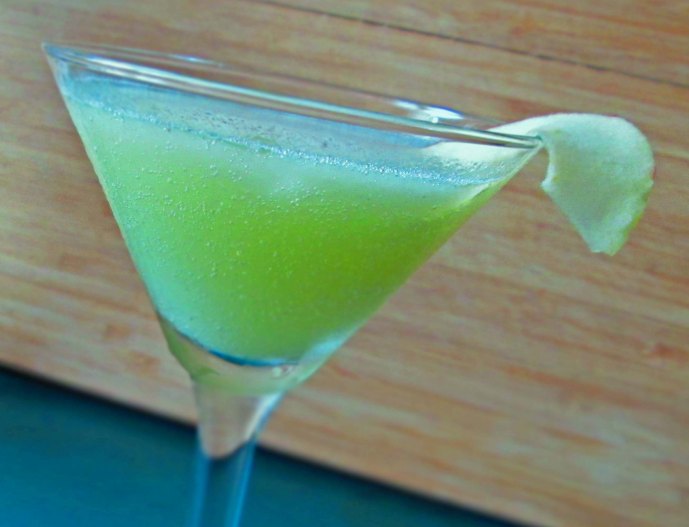
Apple Cocktail
Makes 2 cocktails.
2 oz. green apple puree 4 oz. apple rum ice Garnish: Sliced apples (optional)
Combing the puree and rum in a blender. Add a few ice cubes and puree. Pour into 2 martini glasses. Garnish the edge of the glasses with apple slices.
It would seem I’m on a watermelon kick (last time, I did a recipe for watermelon pickles). But that’s what happens when you buy a big watermelon and are the only one eating it. You find different ways to use it.
This week, I offer you a refreshing drink with a kick to it. I call it Watermelon Lovely because it truly is lovely to look at. It’s very easy to throw together, and it makes the perfect summer libation.
Enjoy!
Watermelon Lovely
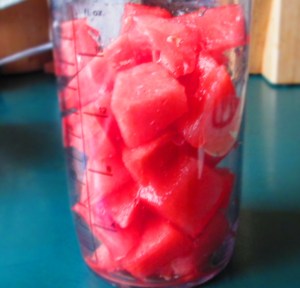
3 cups chopped, seeded watermelon, preferably cold 2 tablespoons dark or light rum (more if you want it stronger) 2 tablespoons Amaretto di Saronno (more if you want it sweeter)
Garnishes*Puree the watermelon. You should get approximately 2 cups.
Pour the liquid into a pitcher or something large enough to mix other ingredients into it. If it’s not already cold, add ice cubes, chill it, and then strain it.
Stir in the remaining ingredients. Pour into 2 glasses and serve.
*If you like, you can decorate the rim of the glasses with colored sugar, crystallized herbs (that’s basil in the picture), or chunks of fruit.
As we’re coming into the fall season—and I say that lightly because we’ve been having higher-than-normal temperatures for this time of year—we’re beginning to see the first offerings of the autumn harvests. A little.
Anyway, at my farmers’ market, I spotted cipolline, which are a specific kind of onion and very popular in Italian cuisine. I usually buy a batch and make cipolline in agrodolce (sweet and sour cipolline) for Thanksgiving. But since I spotted these way too early for the holidays, but couldn’t resist buying them, I decided to experiment with my recipe a little. The difference here is booze. I wanted to see what a little alcohol would do to the mixture.
The question was, what type of alcohol did I want to add? I debated between bourbon, vodka, and a liqueur. Ultimately, I went with apricot brandy. It gave the onions a sweet but—not surprising—boozy edge. In short, they’re really good. Give it a try.
Cipolline in Agrodolce (Sweet and Sour Cipolline Onions)
1 pound cipolline onions, outer skin removed 2 tablespoons sugar ½ cup apple cider vinegar ½ cup apricot brandy ½ teaspoon kosher salt ½ teaspoon peppercorns 1 bay leaf ½ teaspoon oregano
Bring a medium pot of water to a boil. Add the onions and lower the heat. Simmer for about a minute or two and drain. When the onions are cool enough to handle, trim them and peel off the tough outer layer.
Combine the sugar and ¼ cup water in a medium pot. Bring it to a boil; lower the heat and simmer until thickened, about 10 minutes.
Add the vinegar and bring to a boil again. Simmer until thickened.Add one cup water, the cipolline, and the remaining ingredients. Bring to a boil. Simmer about 45 minutes.
Remove from the heat and let them cool. Transfer everything to a jar or sealable bowl and refrigerate.
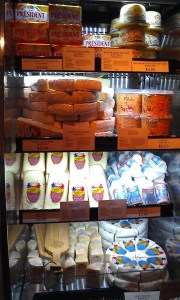
One of the nice things about the holiday season is all the festivities and food. On Wednesday, December 9, I got to do something a little different—I went to a cheese-tasting event at The French Cheese Board on 39th Street in Manhattan. It’s a chic, clean, modern space where you can purchase your favorite French cheeses.
Wheel of Raclette
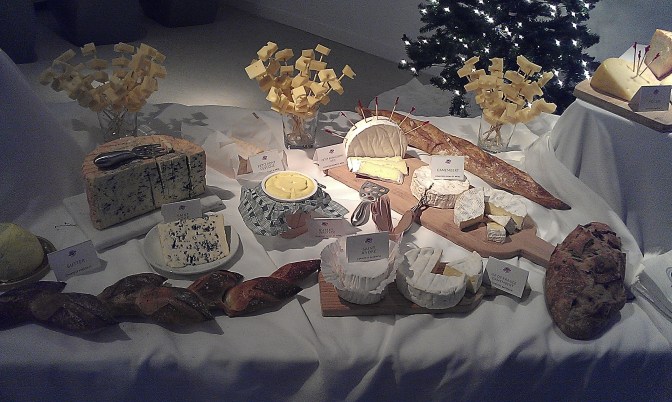
The event was promoted by The Baddish Group, a PR firm that specializes in food and beverage marketing, and they offered a sumptuous spread of several different cheeses, from Camembert and brie to Raclette and butter made with sea salt. They were all so fresh and flavorful that I couldn’t help going back for more. I watched as others kept going back as well, which made me feel kind of bad for the kitchen staff. They were definitely being kept hopping trying to replenish the table. A server came by with a few different hors d’oeuvres: Mac & Mimolette, Brie and Grapes on a canape, and Raclette & Potatoes. The mac ’n’ cheese was so good in its simplicity, cheese and grapes is a classic combination that can never go wrong, and a potato slice with a piece of Raclette on top was divine.
It was a warm, friendly gathering of people in different segments of the food industry. A couple of us were food bloggers, while others were buyers, chefs, and marketers. I’m sure that other professions were represented. Despite the incredible and uncharacteristic warm weather, a simple, lovely Christmas tree along one wall reminded us that it was the holiday season. I think that always puts people in a better mood.
Mimolette
My favorite cheese, by far, was the Mimolette, a pumpkin-colored cow’s milk cheese. It’s a firm cheese, which is my favorite kind, but I really liked it for its smooth, sweet flavor. Which leads me to my favorite drink of the evening.
They asked mixologist Natasha David from Nitecap, a bar on the Lower East Side of Manhattan, to come up with some cheese-inspired cocktails for the event.
Natasha created cocktails that were not only inspired by cheese but that actually used cheese. And not just in the final concoction—her creations were made with spirits that were infused with cheese.
I asked Natasha what her method for the infusions was, and here’s what she said:
The infusions were quite simple—I let the cheese sit in the booze for a certain amount of time, then strained them and froze them so that all the fat would rise to the top and then strained again. I did that twice over 48 hours.
For the Mimolette Rind—I used 50 g of rind to 1 750 ml bottle of Calvados for 7 hours.
For Camembert—I did 60 g of Camembert to 1 750 ml bottle of Dorothy Parker gin for 5 hours.
For Bleu—I did 50 g to 1 750 ml bottle of Linie for 2 hours.
From there, the mixologists at the event concocted the three drinks below to accompany the hors d’oeuvres. I’m going to give an infusion a try at some point—it will definitely be a new experience for me. If you do it yourself, let me know how it turns out. Enjoy!
Cheese-Infused Cocktail Recipes
Cocktail #1: To accompany the Mac & Mimolette, a Mimolette Rind-Infused Calvados cocktail
2 oz. Rind-infused Busnel Calvados 0.75 oz. Lemon Juice 0.5 oz. Simple Syrup 1 barspoon Bon Mama Fig Preserves Egg White
Method: Shake, Strain Glass: Double Rocks glass with Big Block of Ice Garnish: Grated Mimolette
Cocktail #2: To accompany Brie and Grapes, a Camembert-infused Gin cocktail
2 oz. Camembert-infused Dorothy Parker Gin 0.75 oz. Lemon Juice 0.5 oz. Ginger Syrup 1 barspoon Lingonberry Preserves Seltzer
Method: Shake, Strain, Top w/ Seltzer Glass: Highball with Kold Draft Garnish: Candied Ginger
Cocktail #3: To accompany Racelette & Potatoes, a Bleu d’Auvergen-infused Aquavit
1.5 oz. Blue-infused Linie Aquavit 0.75 oz. Dolin Dry Vermouth 0.75 oz. Dolin Blanc Vermouth 1 tsp. Pickled Tomato Brine
Method: Stir, Strain Glass: Nick and Nora or Martini Garnish: Blue cheese stuffed Pickled Tomato
This is my friend Tucker. He wanted to do something classy this holiday season.
Last week, I made guava puree from fresh guavas that I had found at the market and made guava quesadillas. I had plenty of puree leftover and promised you a guava cocktail. So now I’m delivering.
Guava puree makes for a complexly flavored drink, but also a sweet drink. So, if you prefer your drinks less sweet, you may want to cut back on the guava. Increasing the amount of rum—as good as that sounds—won’t cut the sweetness—it will just make a really strong drink!
I had purchased (unknowingly) white guavas instead of pink ones. If you get white guavas, you might want to throw in a bit of grenadine for a deliciously red color. The pictures you see here were taken before the grenadine. I stirred some in later and decided that I liked it, but it was too late for photos.
So, while the summer is hanging on by thread and guavas are still appearing at the market, grab some and try this drink. For the rest of the year, use guava paste, which I discuss HERE.
Enjoy!
Guava Cocktail
2/3 cup guava puree ½ cup spiced rum ¼ cup freshly squeezed orange juice 1 teaspoon grenadine Garnish: orange slices and/or mint sprigs
Place all the ingredients in a blender, along with a few ice cubes. Blend until smooth. Pour into 2 glasses and garnish with an orange slice and/or a sprig of mint.
I was passing by a market that had some fruit on display outside. I was paying no attention to it, but something caught my eye. They had a box of mini round watermelons. They looked so cute, I had to have one. So, I picked one out and took it home. (I paid for it first, of course.)
When I cut it open, I discovered that it was a yellow watermelon. They hadn’t labeled it yellow—the sign only said “sweet.” I love finding yellow watermelons. They’re like yellow topazes, sparkling in the light.
Unfortunately, it was a lot prettier than it was tasty. They lied. It wasn’t sweet.
Now I had to find a way to enjoy this melon without resenting the money I paid for it.
So, I cut it up and put some booze in it. But not just any booze. I had this beautiful elderflower rum that I picked up at a farmers’ market in Vermont and it paired perfectly with the melon. Then I decided to mash it and make it into a slushy.Continue reading →
It’s the last weekend before Christmas. For many of you, the tree’s been trimmed, the stockings have been hung by the chimney with care, the presents are wrapped and waiting under the tree, and the cookies for Santa have been baked. For many of you, this frenzy will continue for the next few days until Santa Claus is on the radar over Singapore.
For both of these groups of people—and even for those who don’t like Christmas and feel that it’s a time of year you must endure—the best thing I could think to off this week is an alcoholic beverage.
Apple cider is everywhere this time of year and it’s not unknown to add a dash or whiskey of bourbon to enhance its qualities. I thought I’d try something slightly different: apple cider, gold rum, and apricot brandy.
If you’re still looking for a cool, refreshing, but yummy drink to serve at your Memorial Day picnic or barbecue, look no further. I’ve got you covered right here.
I had this little bottle of coconut vodka that I wanted to use, and while I was out shopping the other day, I came across one of those coconut juice drinks with the little pieces of coconut in it. Hmm, I said to myself. I think this would be a great mixer for that coconut vodka.
And that’s what I did. I poured the vodka over a little ice and added the coconut drink. It was okay but it needed something. So I squeezed in some lime. That was it. Let me tell you, coconuts and limes are often paired together for a reason! They’re like Antony and Cleopatra, beans and rice, Abbott and Costello—they just belong together (well, at least the beans and rice and Abbott and Costello).
So, here’s my recipe for a Coconutty-Limey Drink. It serves one but can be batched, and it works well with coconut rum, too.
Coconutty-Limey Drink
2 oz. coconut vodka (or rum)
1 1/4 cups coconut juice drink with pulp
2 wedges from a medium lime
Place a couple of ice cubes in a glass. Pour in the vodka and coconut drink. Squeeze in the juice from one wedge of lime. Squeeze in the juice from the other wedge and add the wedge to the glass Serve.
A few weeks ago, I bought apple slices canned in syrup. I used the apples in apple corn muffins (recipe HERE) and saved the syrup (because of its sugar content, it can stay quite a while in the refrigerator).
One of my suggestions for the leftover syrup was to make drinks with it. I finally had a opportunity to try a couple out. I must say, they turned out deliciously, so I wanted to share them with you.
If you can’t find canned apples in syrup, you can make your own: Slice 2 apples and place them in a small saucepan with 1 cup water and 1/4 cup sugar. Bring to a boil; lower the heat and let simmer about 20 minutes, covered. Then strain the liquid out over a small bowl.
So here are my successful apple syrup recipes. Both make 1 serving.
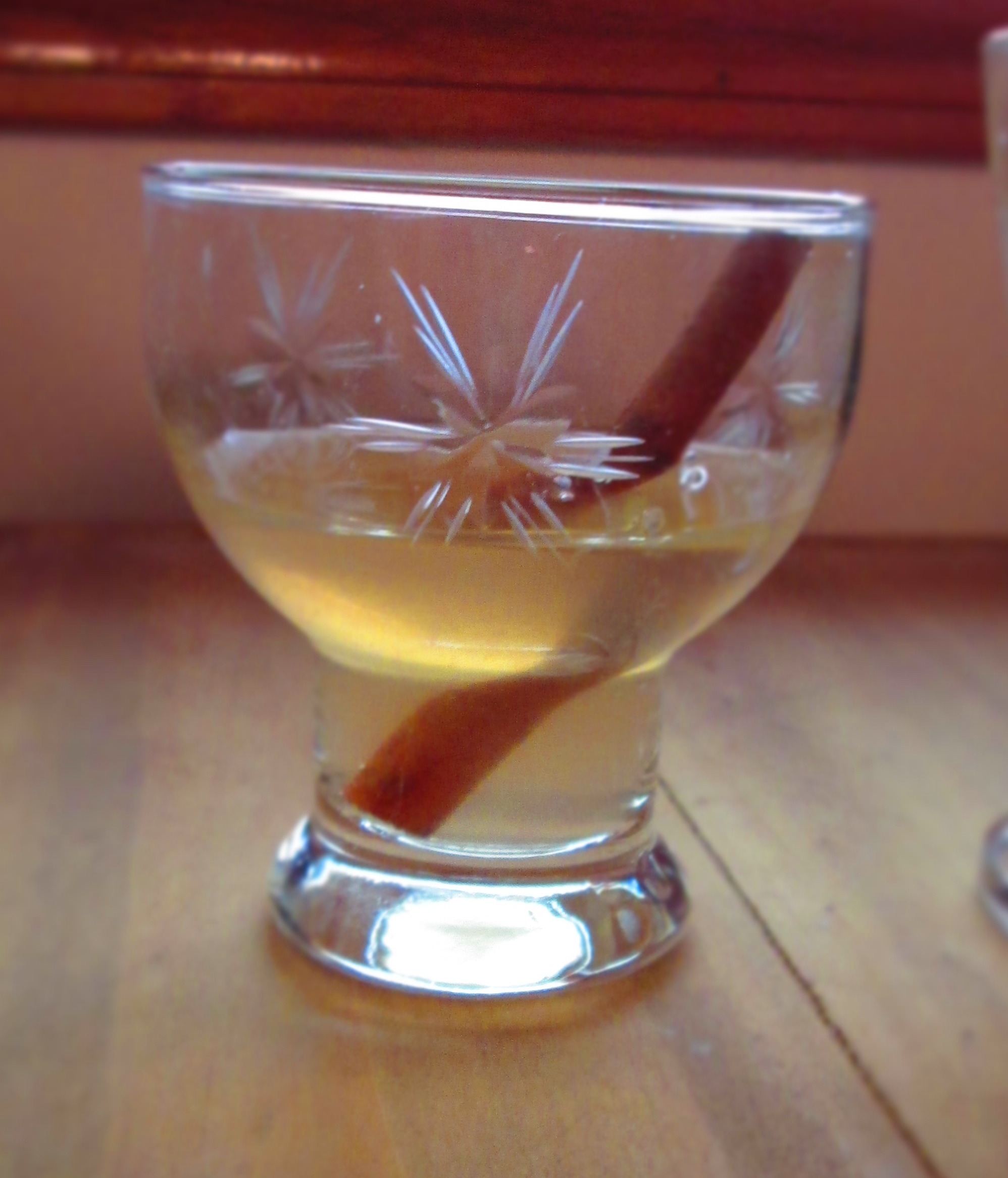
Spiced Apple Shooter
1 ounce Captain Morgan rum
1 tablespoon apple syrup (strained)
1 tablespoon water
1 teaspoon lemon juice
Cinnamon stick
Combine all ingredients, except cinnamon stick, in a shaker with ice. Strain out into a shot glass. Place the cinnamon in the glass and serve.
Spiced Apple Shooter
Apple-Cacao Aperitif
1 ounce white rum
1 ounce white crème de cacao
1 tablespoon apple syrup (strained)
1 teaspoon lemon juice
Lemon zest
Combine all ingredients, except zest, in a shaker with ice. Strain into a small aperitif or cocktail glass.
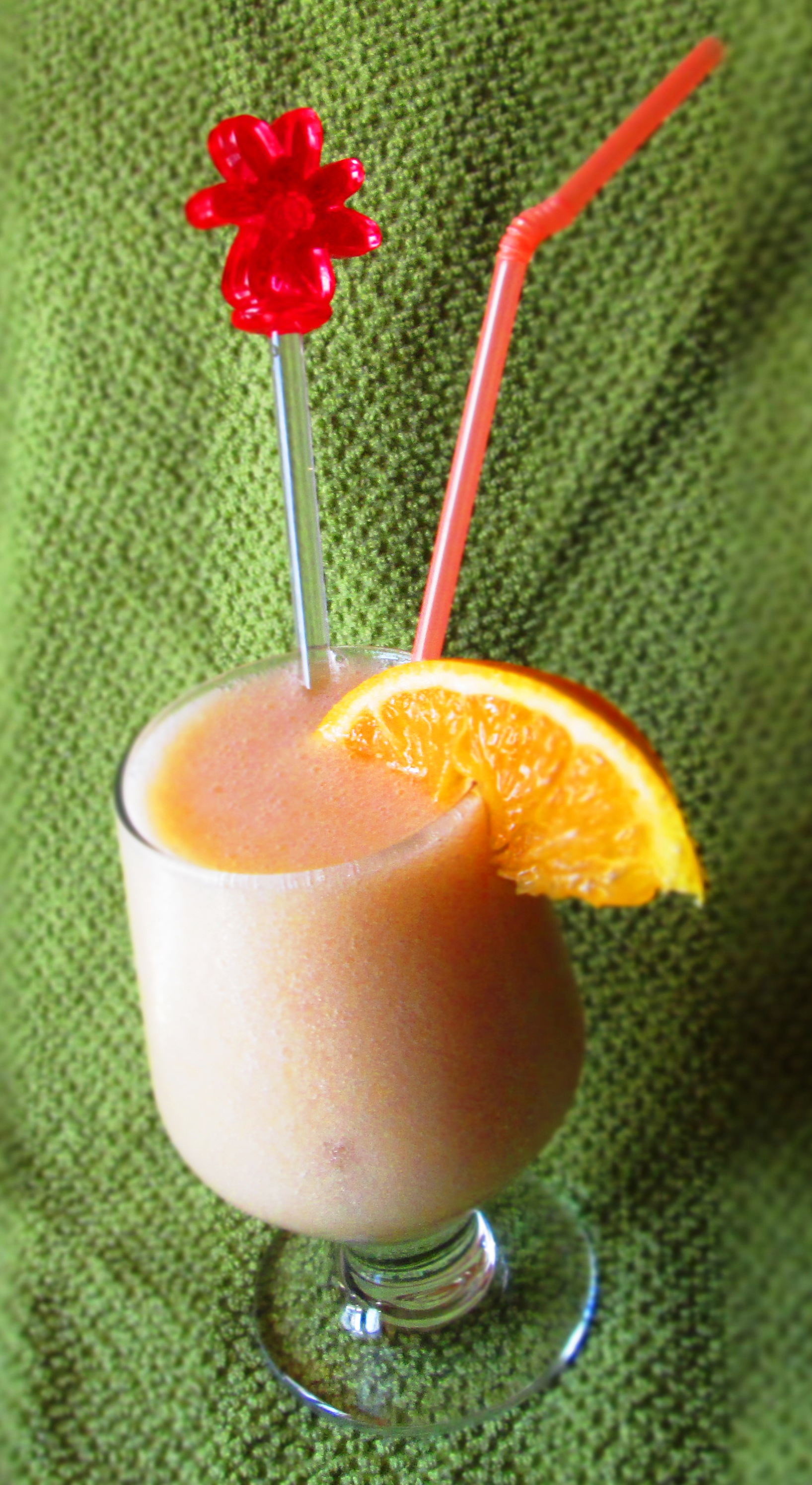
This was a particularly difficult month and week for me, so I decided that this week’s recipe should be a cocktail. I had quite a few cocktails and glasses of wine this month to get me through, but this one turned out nicer than I had expected. I used homemade limoncello, but any brand that you get from the store will do.
It’s a bit on the sweet side, so give it a taste. If you want to tone down the sweetness, add a little less o.j. and/or a bit more rum. It’s called “sunrise” because it looks like one of those types of drinks that are reminiscent of…well, sunrises. Little umbrella optional. :- ) Enjoy!
Limoncello Sunrise
1 ounce limoncello
1 ounce rum
4 ounces freshly squeezed orange juice (~2 juicing oranges)
1 tablespoon grenadine or strawberry syrup
1 orange slice
¼ cup crushed ice or 1 or 2 cubes
Place ice in a tall glass. Add the limoncello, rum, and orange juice and mix. Pour in the grenadine or syrup and let it settle at the bottom. Garnish the glass with the orange.


 Listen, it’s just been too damn hot to cook. The dog days of summer are upon us. Temperatures are making the mercury in (old school) thermometers cry, and you could fry your entire breakfast on the streets. Understandably, you don’t want to be in the kitchen for any longer than it takes to pour a glass of lemonade.



 Add one cup water, the cipolline, and the remaining ingredients. Bring to a boil. Simmer about 45 minutes.

 It was a warm, friendly gathering of people in different segments of the food industry. A couple of us were food bloggers, while others were buyers, chefs, and marketers. I’m sure that other professions were represented. Despite the incredible and uncharacteristic warm weather, a simple, lovely Christmas tree along one wall reminded us that it was the holiday season. I think that always puts people in a better mood.




 Memorial Day picnic or barbecue, look no further. I’ve got you covered right here.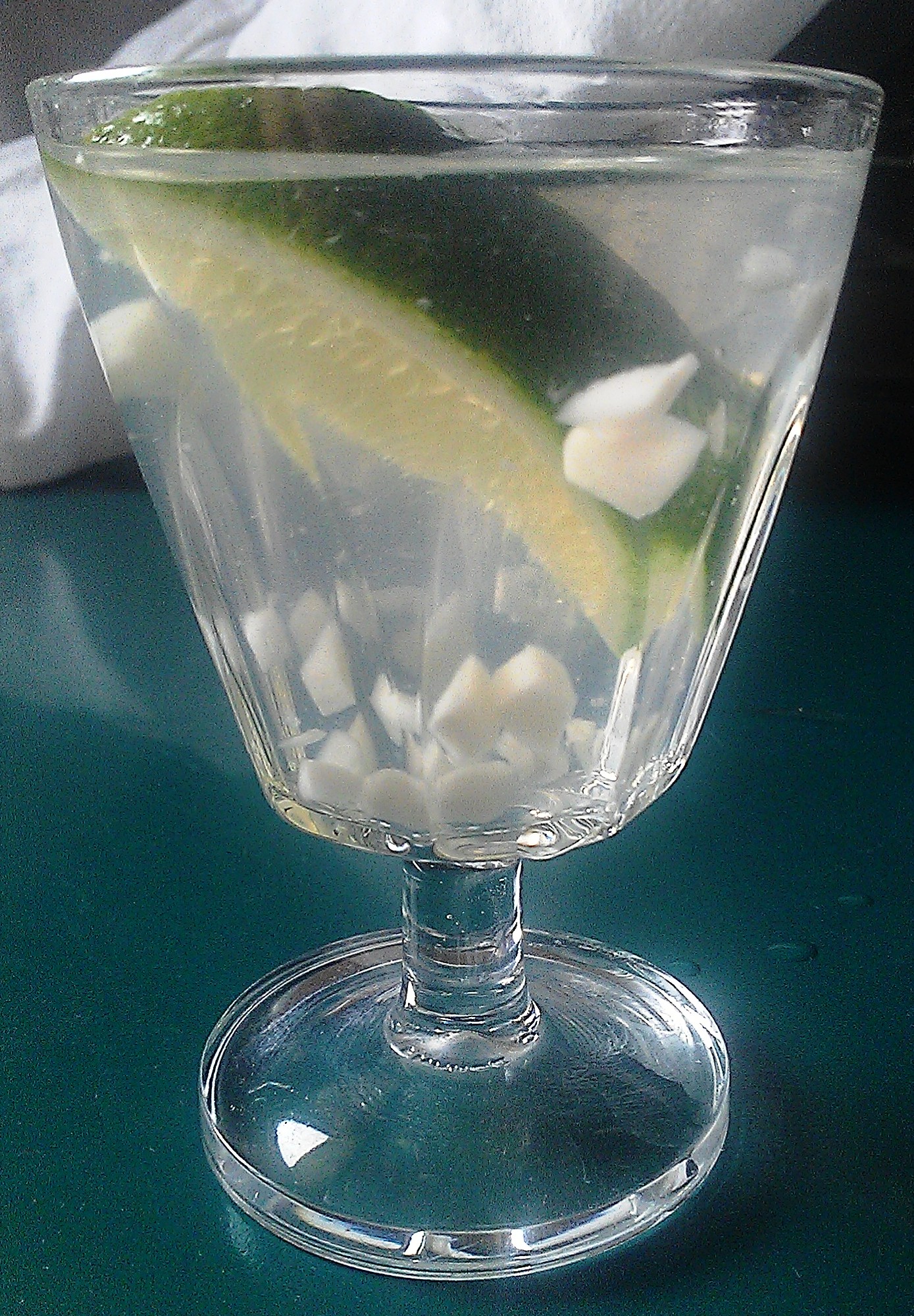



 Miz Chef